Part 1: Could we have known sooner?
Fred Samuels CEO of Cell-El, instituted a company Journal Club about three years ago. Once every six weeks, a member of the Cell-El team presents a peer reviewed article that has been published. The Cell-El blog is running a series of posts based on Journal Club presentations. Now you will know what we are curious about and what new developments have been seen in ASD research.
For parents raising a child with autism spectrum disorder (ASD), one of the most painful and persistent questions is: Could we have known sooner? Could anything have been done earlier? A new scientific study — while still in the research stage — takes a meaningful step toward answering some of those questions, and the findings are genuinely hopeful.
Researchers at the University of California, led by Dr. Robert Naviaux, published a study: “Metabolic network analysis of pre-ASD newborns and 5-year-old children with autism spectrum disorder” in Nature: Communications Biology (May 2024). Dr. Naviaux has spent his career studying how cells produce and use energy. He looked at the chemistry happening inside children’s blood. Dr. Naviaux describes it simply: “Metabolism is the language that the brain, gut and immune system use to communicate — and autism occurs when the communication between these systems is changed.” In other words, the way a child’s body processes energy and nutrients isn’t just about physical health. It’s deeply connected to brain development, behavior, and how the nervous system wires itself.
What makes this study remarkable is when the differences were found. The researchers examined dried blood spots — the tiny samples taken from newborn heels as part of routine hospital screening — from babies who were later diagnosed with ASD. Even at birth, before any behavioral signs had appeared, the blood chemistry of these babies looked different from that of typically developing children. Fourteen distinct chemical pathways were abnormal in both the newborns and in 5-year-olds with ASD, suggesting these differences aren’t random — they follow a pattern.
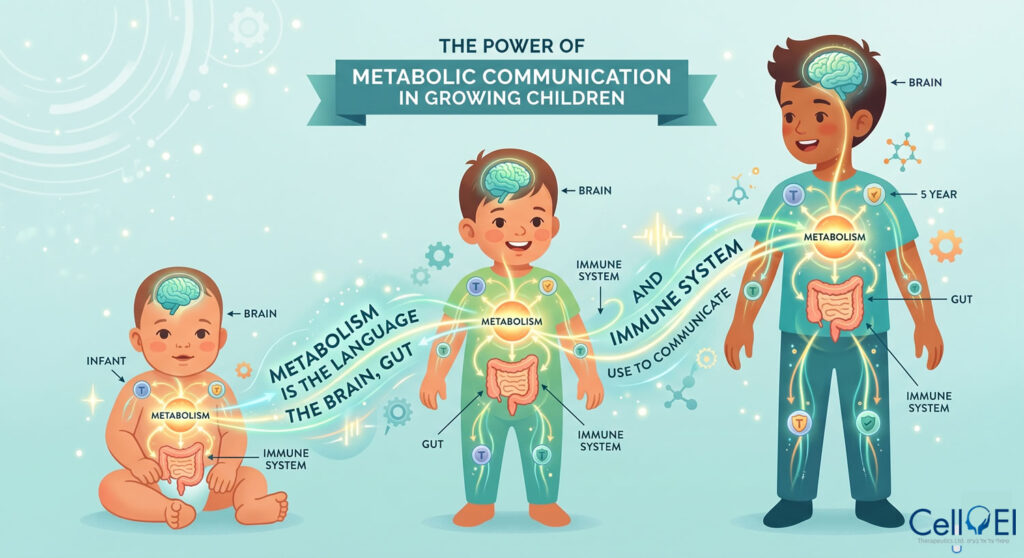
Infographic: AI-assisted visualization based on the referenced scientific literature.
One of the key findings involves a group of molecules called purines — building blocks of DNA that also act as chemical messengers in the brain. In typically developing children, something important happens between birth and age 5: the brain’s signaling gradually shifts from a highly excitable state toward a more balanced, calmer one. It’s part of how children learn to regulate themselves.
Naviaux’s team found evidence that the purine signaling system was already altered at birth in babies who later developed ASD. By age 5, the difference became even more pronounced. In typically developing children, the purine network undergoes a dramatic developmental reorganization that helps regulate cellular communication. In children with ASD, this maturation process appeared to be incomplete, suggesting that the biological differences seen at birth may persist throughout early childhood.
Rather than completing the developmental transition seen in typically developing children, the purine signaling system in children with ASD appeared to remain in a more excitable state. This may help explain why many children with ASD are more sensitive to sensory experiences such as loud sounds, bright lights, or unexpected changes in routine. Their brains are not malfunctioning; rather, the biological systems that help regulate and dampen incoming signals may be functioning differently from a very early age.
The researchers also found that children with ASD had lower levels of several protective molecules — natural antioxidants and cellular repairmen like glutathione and CoQ10 — alongside higher levels of stress-related chemicals. This chronic stress state, which the researchers call the “Cell Danger Response (CDR),” appears to be a central part of what goes wrong in ASD — not a single broken gene, but a system stuck in alarm mode. The encouraging part is that systems can be reset. Several experimental therapies targeting exactly this pathway are currently being explored in clinical trials.
Can autism be detected earlier than the current diagnostic age? Can parents know if their child has ASD at infancy? Researchers including Cell-El are working to answer these questions. Cell-El’s AI-powered technology analyzes a blood-based protein biomarker (proteomic) panel to identify patterns that differentiate children with ASD from typically developing peers. To further understand the differences and how ASD may become apparent in the cells at a young age, Cell-El has expanded the study to include infants who have not been diagnosed with ASD and who are siblings of children with ASD. If you have a child who fits the criteria for the Cell-El infant study, please contact Leah at [email protected] .
Help Us Help You
Better diagnostics for ASD based on laboratory-measured objective biomarkers can possibly enable researchers and clinicians to provide more precise and personalized treatment. You too can make a difference in the lives of children with ASD and their families by joining the Cell-El study. Cell-El is recruiting the following cohorts: High risk infants aged 10-18 months and their mothers; 2-12 year olds who are typically developing, or with autism; 2-18 year olds pre and post Stem Cell Therapy (SCT). Please note: At this time we are only recruiting participants residing in Israel.
Please contact Leah at [email protected] or fill out the form to find out about eligibility to participate in our diagnostic study and please help spread the word about the Cell-El study. Sharing our study will enable our important biomarker diagnostic tool to be integrated into autism treatment as quickly as possible.
Disclaimer: This content is for informational purposes only and does not constitute medical advice or treatment recommendations. Cell-El Therapeutics Ltd. does not endorse any specific therapies mentioned. Always consult a qualified healthcare professional before making medical decisions. Read more